Why More Staff Won't Solve Home Health Backlogs
Home Health, Operations, Staffing
Why Adding Headcount Won’t Fix Your Home Health Backlog
Many home health agency owners reach for the same solution when work piles up: hire more people. Yet backlogs often remain, costs climb, and stress increases. This article explains why adding headcount rarely solves a backlog problem on its own, and what to improve first instead.

Stop Fighting Backlogs With More Staff
Fix your processes before you grow your team
1. Why Adding Headcount Doesn’t Fix a Backlog Problem
A backlog is not just “too much work.” It is usually a sign of process issues: unclear handoffs, inconsistent documentation, slow approvals, or manual data entry. When you add more people into a broken process, you often:
Increase communication time (more people to coordinate, more meetings).
Create more variation in how tasks are done, leading to rework and compliance risk.
Add overhead for supervision, training, and quality checks.
The result: the backlog may move from one step to another, but it does not disappear. In some cases, it even grows because the system becomes more complex and slower to manage.
2. Headcount Fixes Capacity, Not Flow
Think of your agency like a patient care pathway. Capacity is how many visits, claims, or authorizations your team could handle in theory. Flow is how smoothly that work moves from referral to visit, documentation, billing, and payment.
Adding headcount increases capacity: more nurses, more schedulers, more billers. However, if your flow is blocked by slow approvals, missing information from hospitals, or repeated chart corrections, extra capacity just means more people waiting at the same choke points. The queue gets longer; the experience does not improve for patients, families, or staff.
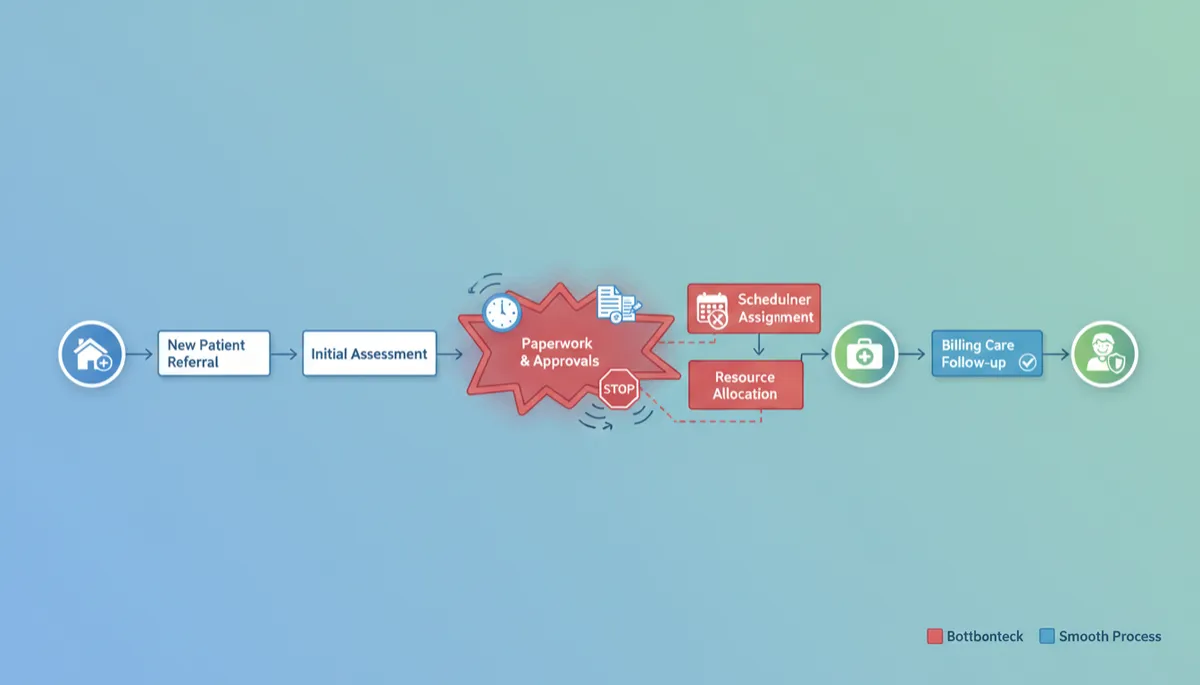
Mapping your workflow often reveals that one or two steps slow everything down.
3. New Hires Inherit the Same Bottlenecks
In many home health agencies, the real bottlenecks are concentrated around a few critical people: the clinical director who must review all orders, the one scheduler who understands every family’s preferences, or the senior biller who can fix any denial. When you add staff around these individuals without changing the process, new hires simply join the queue waiting for those same people.
Your new nurse still waits for the same late signatures. Your new coordinator still chases the same missing documents. Your new biller still stands in line for the same approvals. Headcount changes who is waiting, but not what they are waiting for.
4. The Hidden Ramp‑Up Costs of New Staff
Hiring is not just a salary decision. Every new person brings ramp‑up costs that often make backlogs worse before they get better:
Time from senior staff to train them on your EMR, payor rules, and documentation standards.
Slower work speed during the first 3–6 months while they learn your patient mix and cultural expectations.
Higher error rates that can create even more rework, denials, and compliance risk.
If your key people are already overloaded, diverting their time to onboarding can actually increase the backlog in the short term. Without process improvements, you are paying more for a system that still struggles.
5. What to Check Before You Hire Another Person
Before posting a job ad, walk through your workflow from referral to payment and ask:
Where is the real bottleneck? Identify the step with the longest waiting time or the most rework, not just the noisiest department.
Can we standardize? Create clear checklists for admission, visit notes, and billing packets so staff spend less time guessing and correcting.
Can we automate? Use your EMR to auto‑populate fields, set reminders, and reduce manual tracking in spreadsheets or messaging apps.
Can we reassign work? Move non‑clinical tasks away from nurses and therapists so they can focus on visits and documentation.
Can we train differently? Short, focused refreshers on documentation or payor rules may clear more backlog than another full‑time hire.
If, after these steps, the bottleneck is still a single role with clearly defined, efficient tasks, then hiring may truly be the right move. But now you will be adding staff into a stronger system, not a broken one.
6. Why Fixing Process Issues Often Delivers Better Results
For many agencies, small process changes have produced gains equal to adding one or two full‑time staff—without the ongoing salary and turnover risk. Some examples include:
Standardizing admission packets so nurses collect everything in one visit, reducing back‑and‑forth calls.
Setting daily cut‑off times for documentation, so billers receive complete charts on a predictable schedule.
Creating simple dashboards to see where cases are stuck and intervene early.
💡 Key Takeaway: Improve the way work moves through your agency before you increase the number of people doing the work. A smoother process makes every current and future hire more valuable.
Final Thoughts for Home Health Owners
In many cultures, caring for elders is deeply personal, and home health agencies carry that responsibility with pride. Protecting that mission means building an operation that is not only compassionate but also efficient. The next time your backlog grows, resist the instinct to hire first. Instead, diagnose your process, clear the bottlenecks, and then decide whether new headcount is truly needed.


