Hidden Costs of Slow QA in Home Health
Home Health, Quality Assurance, Clinical Operations
The Hidden Costs of a Slow QA Turnaround in Home Health: Why the Backlog Isn’t the Real Problem
A growing QA backlog looks like the fire you have to put out, but for most home health agencies, it’s really just the smoke. The real fire starts much earlier—at the point of documentation—where clinicians work under pressure, optimize for speed, and unintentionally plant the seeds for future delays, denials, and compliance risk.
The Hidden Costs of a Slow QA Turnaround
When QA turnaround slows from 24–48 hours to 5–7 days—or longer—the impact isn’t limited to a few frustrated clinicians. A slow QA cycle quietly erodes your agency’s financial performance, compliance posture, and staff morale in ways that often go unmeasured:
Delayed billing and cash flow: Every extra day QA holds documentation is another day revenue is sitting in limbo. Multiply that across your census, and the cash-flow drag becomes significant.
Increased risk of denials: When errors are caught late, corrections may be incomplete, rushed, or based on fuzzy recollection of the visit. That raises the odds of documentation that doesn’t fully support medical necessity or coverage criteria.
Wasted clinician time: Asking a clinician to “fix” a note from a visit they completed 10 days ago forces them to re-open a mental file that’s already closed. The cognitive switching cost is high, and the time they spend reworking old visits is time they’re not seeing new patients or documenting current care.
Burnout and disengagement: Constant QA “surprises” from weeks-old visits feel punitive, even when that’s not the intent. Over time, clinicians may disengage, seeing QA as a barrier instead of a partner in quality care.
All of this is costly, but it’s important to recognize that the backlog itself is not the true problem. It’s a symptom of a deeper operational issue: when and how documentation errors are created—and when they are discovered.
The QA Backlog Is a Symptom, Not the Problem
A large QA queue is easy to see and measure. You can pull a report and know exactly how many documents are pending review and how long they’ve been sitting. That visibility makes the backlog an easy target for blame: “We’re behind because QA is too slow” or “We just need more reviewers.”
But in most home health agencies, the backlog is simply where a chain of problems becomes visible. The real damage occurs upstream, at the point of documentation, when visit notes, OASIS assessments, and care plans are first created—often under intense time pressure and competing demands.

Documentation choices made in rushed moments ripple downstream into QA, billing, and compliance.
Where the Real Damage Happens: Upstream at the Point of Documentation
Consider what’s happening in the field. Clinicians are juggling full caseloads, travel time, complex patients, and family dynamics. They know documentation is critical, but they’re also acutely aware of productivity expectations and visit quotas. In that environment, it’s natural for them to optimize for speed over accuracy.
That doesn’t mean they don’t care about quality. It means they’re making real-time tradeoffs: finishing notes quickly in the car, copying forward sections from previous visits, or using vague language that “should be fine” instead of detailed, defensible documentation. These shortcuts may save minutes in the moment, but they create errors and gaps that only show up days later in QA—if they’re caught at all.
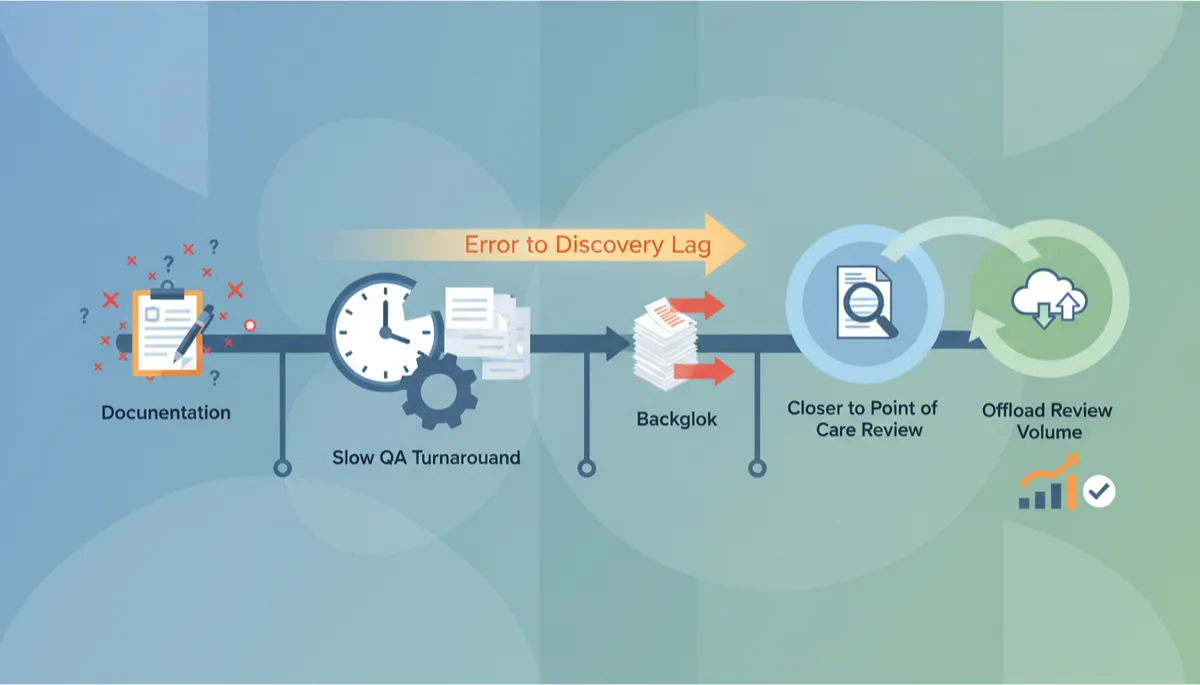
By the time QA reviews the record, the visit is long over. The clinician’s memory has faded, the patient’s condition may have changed, and the opportunity for clean, accurate documentation has passed. This is where the true cost lies: not in the number of items in the QA queue, but in the lag between error and discovery.
The Real Lag: Time Between Error and Discovery
The longer the gap between when an error is made and when it’s discovered, the more expensive it is to fix. When QA turnaround stretches to a week or more, that gap widens significantly. By then, clinicians may have documented dozens of additional visits using the same flawed habits, and your agency may already be building a billing and compliance risk profile around those patterns.
In other words, the true operational metric to pay attention to is not simply “QA days outstanding,” but the error-to-discovery window—how long it takes your organization to surface and correct documentation issues after they’re created. Shortening this window is where you see real gains in quality, efficiency, and clinician satisfaction.
Why Blaming Clinicians Doesn’t Work
When QA issues pile up, it’s tempting to focus on individual performance: more coaching, more warnings, more reminders to “slow down and be more accurate.” But if your documentation environment still rewards speed and volume, these messages ring hollow. Clinicians will continue to optimize for what they believe leadership values most—usually productivity and visit counts.
Blaming individuals also ignores the systemic nature of the problem:
Documentation workflows that encourage end-of-day or end-of-week batching.
EMR templates that are confusing, redundant, or not aligned with payer expectations.
Productivity standards that leave little room for thoughtful, thorough documentation at the point of care.
You don’t fix systemic issues with individual blame. You fix them by redesigning the process so that accurate documentation is the easiest, fastest path—not an extra burden. That’s where strategic changes to your QA model can be transformative.
Strategy #1: Review Documentation Closer to the Point of Care
One of the most effective ways to shorten the error-to-discovery window is to move QA review as close as possible to the point of documentation. That doesn’t always mean real-time, but it should mean within a day or two of the visit—not a week or more later.
Near-real-time feedback: When clinicians receive QA feedback while the visit is still fresh in their minds, they can correct errors quickly and understand exactly what needs to change. This turns QA into a learning loop, not just a gatekeeper.
Reinforced good habits: Catching and correcting issues early prevents them from becoming ingrained habits that show up across dozens of notes and episodes.
Cleaner documentation for billing: Early review ensures that by the time claims are submitted, records are already complete, consistent, and defensible.
💡 Pro Tip: Set a standard that key documents (like OASIS and SOC notes) are reviewed within 24–48 hours of completion, and track this metric as closely as you track days in accounts receivable.
Strategy #2: Remove Review Volume from Internal Teams to Prevent Backlogs
Even with better processes, many agencies simply don’t have enough internal capacity to keep QA turnaround times consistently low—especially during peaks in census, staff turnover, or regulatory change. When internal teams are overloaded, backlogs are inevitable, no matter how hard people work.
One way to break this cycle is to remove a portion of review volume from your internal QA team. Whether through specialized external partners, overflow support, or technology-enabled review, the goal is to prevent backlogs from forming in the first place by right-sizing capacity to demand.
Your internal QA staff can focus on high-risk, high-complexity cases, education, and trend analysis instead of drowning in routine volume.
Turnaround times stay predictable, even when referrals spike or staffing fluctuates.
Clinicians experience fewer delays and fewer “surprise” QA edits weeks after the fact, which improves trust and collaboration.
How These Strategies Improve Clinician Efficiency and Reduce Backlogs
When you review documentation closer to the point of care and prevent QA from becoming a bottleneck, you do more than clean up a report. You change how clinicians experience their workday and how efficiently your entire organization operates.
Shorter error-to-discovery window: Issues are found and fixed while details are fresh, reducing rework time and cognitive load. Clinicians can correct and move on, instead of revisiting old visits over and over.
Higher-quality first-pass documentation: Rapid feedback teaches clinicians what “right” looks like, so their notes improve over time. That means fewer QA touches per document and less friction in the workflow.
Improved clinician efficiency: With fewer late-stage corrections, clinicians spend more of their time on direct patient care and current documentation, which supports both productivity and job satisfaction.
Reduced QA backlog: As documentation quality improves and review capacity is better aligned with volume, the backlog naturally shrinks. QA can shift from firefighting to proactive quality improvement—exactly where it delivers the most value.
Rethinking QA: From Bottleneck to Strategic Advantage
For home health agency owners, the takeaway is clear: a slow QA turnaround is not just a workflow annoyance—it’s a hidden cost center. But the answer isn’t simply to push your QA team harder or ask clinicians to “do better.” It’s to redesign your processes so that documentation is accurate the first time, errors are discovered quickly, and review capacity matches real-world demand.
When you stop treating the backlog as the problem and start addressing the upstream causes—the pressure to prioritize speed over accuracy, the long lag between error and discovery, and the mismatch between volume and internal QA capacity—you unlock a different kind of result: faster cash flow, stronger compliance, more efficient clinicians, and a QA function that truly supports high-quality care.
In that model, the QA backlog doesn’t just shrink—it stops defining your operations. Instead, it becomes what it was always meant to be: a tool for continuous improvement, not a chronic crisis you’re constantly trying to outrun.


